Skip to content
Posts in Category: Games
Sails of Glory review
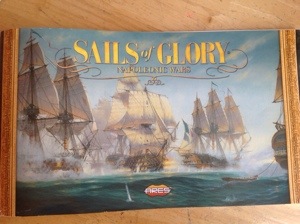
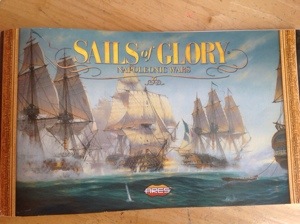
Sails of Glory is a miniatures based naval combat game from Ares Games that is a great way to fight ship to ship in the age of sail. The game has similar mechanics to Ares airplane game Wings of Glory or X-Wing from Fantasy Flight. Each player selects actions in secret and reveals what they are planning to do at the same time. Movement resolves at the same time and then players get to make a shoot/no shoot decision. Damage is resolved at the same time as well, so there’s always a risk you’ll take damage if you are within the range of enemy guns. You enter the reload phase and start the reloading process. Cannons that just fired are cleaned or empty cannons are reloaded. Just like in real life it takes time to reload your cannons. You continue repeating these steps: Plan, Move, Combat, Reload, until one side has surrendered or been driven off the map.
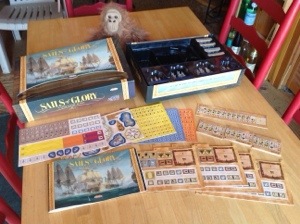
The starter set comes with four ships, a wind indicator, two attitude pointers, and a huge number of counters and tokens. The rule book is 63 pages and is section off into initial setup, basic, standard, advanced, optional rules and scenarios. It took about 45-60 minutes to punch out all the bits. It’s important to keep all the counters separated, especially the ship tokens. Each ship needs to have the same action tokens during advanced play. I can see it might be easy to toss all the ship related bits into a single bag, but if you play the advanced game you’ll have to spend some time sorting and counting to ensure you have the right number of action tokens per ship.
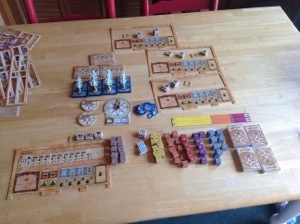 Here is what my set looked like after punch out. Each ship has a ship board, that’s the mat in the lower left corner of the image. The large hole across the top fits a ship’s specific stats board. This is a neat design and allows you to take one of the stats boards from an expansion set ship and place it into the ship board. Damage, actions, and gun status (loaded or unloaded) are all represented on the board.
All the letter/colored counters (A-E, Yellow-Blue) are damage counters. When you fire your cannons at an enemy your range and ammunition determine what tokens you use. You draw a number out of a cup or bag based on your attack rating and the enemy turns over the counters to see the damage. This is a cool mechanic because you dish out damage at the same time to anyone who was shot at in the round.
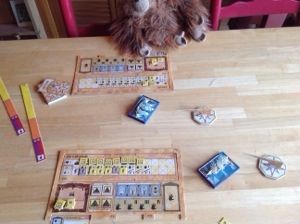 My test game with Louis did not got well for me. We sailed around the table trying to get a first shot. I watch Master and Commander before playing this and took the small English ship where Louis wanted the large French ship. I proved to be no Jack Aubrey and got hammered with two broadsides before I could bring my guns to bear. After taking so much damage my shots were too little too late and her majesty lost a ship to those vile French. The basic game plays a lot like X-wing. You plan, move, shoot, reload and repeat. You have to watch the wind direction; it will determine what movement cards you can select in the plan phase and how effective the move turns out to be. Measuring is not done until you move or declare a shot so you may not know exactly if you are going to move as far as you want or hit your target. As your ship takes damage it becomes less capable and that makes it harder to do damage to the enemy.
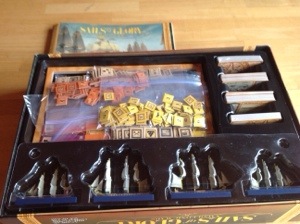 The one thing I was worried about with a game with SO MANY tokens is how to put it away. I was happy that there is a large cutout in the form under the rule book that holds most of the tokens in snack baggies. The wind gauge and indicators have their own spots in the form. The mats and rulers fit in the large space in the upper right. Each deck and ship fits in its own space. It’s very nice to have a game with so many bits fit back in the original box and not require special extra boxing (I’m looking at you X-Wing Fantasy Flight!) The next time this hits the table I am going to try out the standard rules, which adds a little more complexity by giving the player an option for ammo to load (chain and grape shot) and creates more realism in planning phase by creating a two step process where you select a move for the next turn. This requires you to plan two steps at a time because a ship doesn’t respond as quickly as a plane or a TIE fighter.
Red Dragon Inn 4 Review
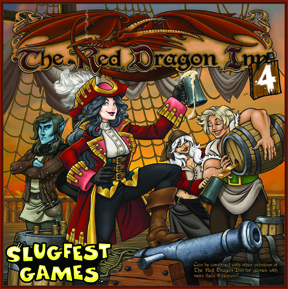
 The Red Dragon Inn series of games is a card game where the players are sitting around in an Inn drinking, gambling, and rough housing. If you drink too much, lose too much gold, or get too beat up you’re out! The last person standing wins.
Number four is pirate themed. That’s an almost must buy for me. I wanted something fun and easy to play with the kids.
There are four big box sets, each with four characters, and five single character expansions. The box contains:
- a deck of cards for each player
- a nice board you can use to track your health and intoxication level
- a clear and red glass bead to use on the board
- a drink deck
- gold coins (cardboard punch out pieces)
Number four also includes some extra tokens for one of the players, a sea deck of ocean encounters, and ship tokens.
Game play is pretty simple. On your turn you discard any cards from your hand you don’t like and draw up to seven cards, you play an action card, you buy someone else a drink, and you drink a drink from your pile.
Actions include things that typically hurt other players (loose cannon balls, playing darts and getting poked, having to pay gold, etc) or help you (reduce your intoxication level, heal — aka gain back fortitude, gain some gold, etc) Another action allows you to start a round of gambling in an attempt to win gold away from other players.
After the action phase you buy a drink for another player. You take a drink card off the top of the drink pile and drop it on whomever you like.
Then you take a card from your drink pile and resolve the effect. Typically your intoxication level is going up.
Many of the cards have anytime or sometime keywords. Anytime cards can be played at anytime. Sometimes cards are played in response to something. It’s important to read the cards carefully to see if you can avoid taking damage or drinking when you might have a card that prevents it.
The artwork is a little risque. There’s nothing overtly sexual, but there are well endowed wenches with some cleavage showing on several cards. Alcohol use is central to the game. I play this with my middle school, high school, and college aged children. What better way to learn moderation than a game where if you over drink, you lose.
Apart from a more mature theme the cards have a lot of text on them and required strong reading skills. This definitely isn’t a game for younger kids. With the right group this is a blast.
OSRIC
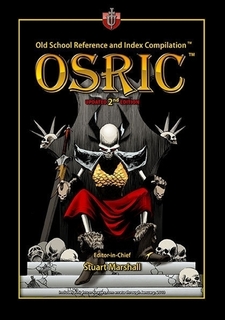
The Old School Reference and Index Compilation is a set of fantasy role play game rules. These rules recreate the rules and feel of RPGs from the 1970-80s.
These rules are free and great pains have been taken to remove any references to licensed intellectual property. The link above will take you to the free download for the book.
If you are looking for the old school feel of Advanced Dungeons & Dragons, this may be the book for you.
In addition to the rules there are many on-line resources for adventure modules (both free and pay.)